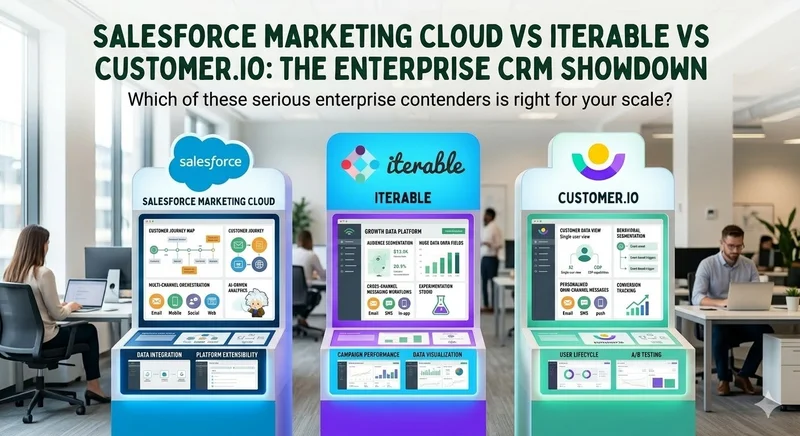
When a business reaches the point where it needs a real marketing automation platform — not just an email sender, but a system capable of orchestrating multi-channel communications at scale, powered by real-time behavioural data — the conversation usually comes down to three names: Salesforce Marketing Cloud, Iterable, and Customer.io.
All three can handle sophisticated journey automation, multi-channel messaging, and complex data integrations. The differences between them are about scale, ecosystem, data model flexibility, and how much your team is prepared to invest in implementation. Getting this decision right sets your marketing infrastructure up for years. Getting it wrong means a costly migration down the road.
Here’s how they genuinely compare.
Salesforce Marketing Cloud: The Gold Standard for Enterprise CRM
Salesforce Marketing Cloud is not just a marketing platform — it’s a customer engagement ecosystem. Built for large enterprises and deeply integrated with the broader Salesforce platform, SFMC is what organizations choose when they want the most powerful, most customizable, and most integrated solution available.
Best for: Enterprise organizations, businesses already running Salesforce Sales Cloud or Service Cloud, and companies that need maximum customization, multi-cloud data unification, and end-to-end customer lifecycle management.
What Salesforce Marketing Cloud does well
- Salesforce ecosystem integration: For organizations on Sales Cloud or Service Cloud, SFMC’s Marketing Cloud Connect integration creates a genuinely unified view of the customer — sales activity, service history, and marketing engagement all in one place. No other platform in this comparison can offer this natively.
- Unlimited customization: AMPscript, Server-Side JavaScript, and a robust REST/SOAP API mean you can build virtually anything. Dynamic content at scale, real-time personalization pulled from external data sources, fully custom email templates — SFMC is the platform where “can we do that?” is almost always answered with yes.
- Data Cloud: Salesforce’s Data Cloud (CDP) allows you to ingest and activate first-party data from across your entire tech stack — your product database, your data warehouse, your point-of-sale system — in real time. This is enterprise-grade data unification that no mid-market platform can match.
- Journey Builder: SFMC’s Journey Builder handles millions of contacts across complex multi-branch journeys with full split testing, goal tracking, and channel-level controls. It is one of the most capable journey orchestration tools on the market.
- Enterprise deliverability: Dedicated IP pools, custom domain authentication, advanced suppression logic, and granular send classification give enterprises complete control over their sender reputation and deliverability infrastructure.
Things to keep in mind with SFMC
- It requires expert implementation: SFMC rewards organizations that invest in a proper implementation — data architecture, business unit structure, subscriber key strategy, and sendable data extension design all need to be right from the start. With a certified implementation partner, this process is well-defined and the payoff is enormous.
- Premium investment: SFMC is priced at the enterprise tier, and the full value of the platform is realized over time as your team and your data architecture mature. Think of it as infrastructure, not a subscription tool.
- Ongoing partnership: The organizations that consistently get the most from SFMC are those with a long-term technical partner who keeps their platform optimized, monitors their automations, and helps them take advantage of each new Salesforce release.
The bottom line: SFMC is the most powerful platform in this comparison. For enterprises already in the Salesforce ecosystem, or for organizations that have genuinely outgrown every other platform, it delivers capabilities nothing else can match. The key is treating implementation as a strategic project, not a setup task — which is exactly how we approach every SFMC engagement at Hesper.
Iterable: Enterprise Multi-Channel Without the Salesforce Ecosystem
Iterable occupies a compelling position: enterprise-grade multi-channel orchestration and governance, without requiring buy-in to the broader Salesforce ecosystem. It’s a strong choice for large organizations that want serious platform capabilities but whose CRM infrastructure doesn’t center on Salesforce.
Best for: Enterprise and upper mid-market companies, businesses with large and diverse user bases, consumer apps and platforms, and organizations that need multi-channel orchestration at scale with strong governance features.
What Iterable does well
- True multi-channel from the ground up: Email, SMS, push notifications, in-app messages, web push, and direct mail are all first-class channels in Iterable — not afterthoughts bolted on. Orchestrating a journey that intelligently routes users across all of these channels, based on their behaviour and preferences, is what Iterable was built for.
- Flexible data model: Unlike platforms with opinionated data schemas, Iterable accepts any user attributes, event data, or catalogue data you send — making it adaptable to non-standard or complex data architectures without forcing you to reshape your data to fit the platform.
- Enterprise governance: Approval workflows, user roles, multi-brand management, compliance controls, and audit logging are all available at a level that enterprise teams need. Iterable is built to operate safely at organizational scale.
- AI-powered optimization: Send-time optimization, channel fatigue management, and predictive goals are mature features that genuinely improve performance at scale without requiring manual tuning.
- Sophisticated experimentation: Journey-level holdout groups, multivariate testing, and statistical significance tracking give data-driven teams the infrastructure to run rigorous experiments across their entire messaging program.
When you’ll be ready to level up
- Deep Salesforce integration: For organizations heavily invested in Salesforce Sales or Service Cloud, SFMC’s native Marketing Cloud Connect is a significant advantage that Iterable can’t replicate without custom API work.
- Maximum customization depth: SFMC’s AMPscript and SSJS offer a degree of custom development flexibility that goes beyond what Iterable supports. For companies that need to build truly bespoke content engines or complex transactional logic, SFMC provides more runway.
- Data Cloud capabilities: If real-time CDP functionality — unifying data from across your entire stack and activating it for segmentation — is a priority, Salesforce Data Cloud is in a different category.
The bottom line: Iterable is a genuinely excellent enterprise platform, particularly for consumer companies and organizations that don’t rely on Salesforce as their CRM backbone. A proper implementation — clean data architecture, structured journey design, and ongoing optimization — unlocks its full potential and delivers meaningful lift in engagement and retention.
Customer.io: Enterprise Capability with Startup Agility
Customer.io is the most agile platform in this comparison — and don’t mistake agility for being less capable. For SaaS companies, subscription businesses, and product-led organizations, Customer.io’s event-driven architecture and developer-friendly design make it a compelling alternative to platforms that require much heavier investment to get running.
Best for: SaaS companies, subscription businesses, mobile apps, and product-led growth organizations that need precise behavioural messaging, developer-friendly tooling, and a transparent, scalable pricing model.
What Customer.io does well
- Fully event-driven: Customer.io’s data model has no rigid schema — you send the events that matter to your business, and build your journeys around them. For product companies with rich behavioural data, this flexibility is transformative.
- Developer-first experience: Clean REST API, Liquid templating, webhook actions, and support for code-based workflow management mean engineering and marketing teams can collaborate effectively. Customer.io can be integrated into a modern data stack cleanly and quickly.
- Multi-channel in one workflow: Email, SMS, push notifications, in-app messages, and webhooks are all available within the same journey builder. Maintaining coherent cross-channel experiences doesn’t require a complex multi-tool setup.
- Behavioural precision: Triggering messages based on exactly what users do — or don’t do — inside your product is Customer.io’s core strength. Trial-to-paid conversion sequences, onboarding journeys keyed to feature adoption, win-back campaigns triggered by inactivity signals — all of these are natural in Customer.io.
- Predictable pricing: Customer.io’s profile-based pricing model is transparent and predictable, with generous event limits — a meaningful advantage for teams managing significant event volume.
When you’ll be ready to level up
- Very large enterprise scale: For organizations managing tens of millions of active profiles, complex multi-brand governance requirements, or regulatory compliance at enterprise scale, Iterable or SFMC offer more infrastructure.
- Advanced reporting: Customer.io’s analytics are solid for most use cases, but organizations that need deep attribution modelling, multi-touch revenue analysis, or complex business intelligence will typically supplement with a dedicated BI tool.
- Salesforce ecosystem: If Sales Cloud or Service Cloud integration is a core requirement, Customer.io handles it via API but lacks the native depth of SFMC’s Marketing Cloud Connect.
The bottom line: Customer.io punches well above its weight for product-led and SaaS businesses. It’s a platform where a lean team with good data architecture can run remarkably sophisticated messaging programs. The key — as with any platform — is investing in the right setup, clean event taxonomy, and thoughtful journey design from the start.
Side-by-Side Comparison
| Salesforce Marketing Cloud | Iterable | Customer.io | |
|---|---|---|---|
| Best for | Enterprise, Salesforce orgs | Enterprise, consumer apps | SaaS, apps, PLG teams |
| Data model | Highly structured, customizable | Flexible, enterprise-grade | Fully flexible (any events) |
| Technical skill required | Very high | High | Moderate |
| Salesforce integration | Native (Marketing Cloud Connect) | API-based | API-based |
| Multi-channel | Email, SMS, Push, In-App, Ads | Email, SMS, Push, In-App, Direct Mail | Email, SMS, Push, In-App |
| Custom development | Unlimited (AMPscript/SSJS/API) | Good | Excellent (developer-first) |
| CDP / Data unification | Salesforce Data Cloud (best-in-class) | Catalog + user data | Event-driven profiles |
| Enterprise governance | Excellent | Excellent | Good |
| Implementation time | Months | Months | Weeks to months |
| Pricing model | Enterprise license | Enterprise license | Profile-based, transparent |
How to Choose
Choose Salesforce Marketing Cloud if: You’re already on Salesforce Sales or Service Cloud, you need maximum customization and enterprise data unification, or you’re an organization that wants the most powerful platform available and is prepared to invest in a proper implementation.
Choose Iterable if: You need enterprise-grade multi-channel orchestration and governance but your CRM stack isn’t built on Salesforce, particularly if you’re a large consumer product, app, or media company.
Choose Customer.io if: You’re a SaaS or subscription business that wants event-driven behavioral messaging, a developer-friendly workflow, and a transparent pricing model — without the overhead of a full enterprise platform implementation.
The Implementation Factor
At this tier of platform, the implementation decision is as important as the platform decision itself. All three of these tools have enormous capabilities — and all three are capable of underperforming in the hands of a team that hasn’t set them up correctly.
The organizations that see the best results from SFMC, Iterable, and Customer.io are those that invest in getting the foundation right: clean data architecture, well-designed journey logic, proper channel configuration, and ongoing optimization from people who know the platform in depth.
Whether you’re evaluating your first enterprise CRM or looking to get more out of a platform you’re already running, our certified CRM team is happy to talk through what the right approach looks like for your business.