Choosing the right email marketing platform is one of the most consequential decisions a growing business can make. Pick something too simple and you’ll outgrow it in 18 months. Pick something too powerful and you’ll spend a fortune on a platform your team can barely use.
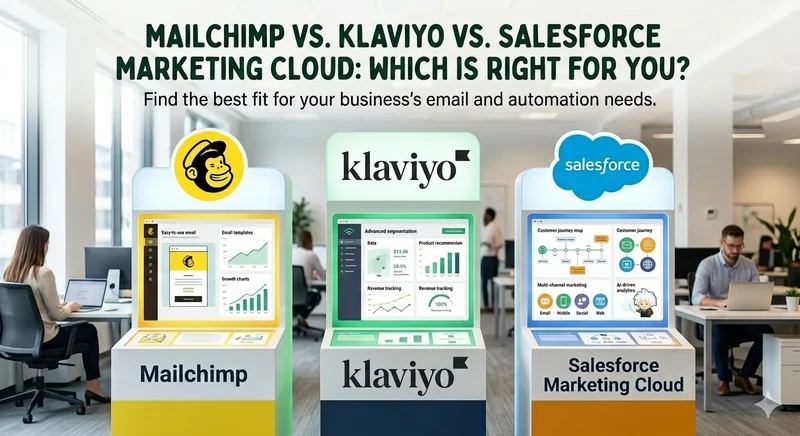
Three platforms dominate the conversation: Mailchimp, Klaviyo, and Salesforce Marketing Cloud (SFMC). They are all capable of sending emails, but comparing them as if they’re equivalent is like comparing a bicycle to a sports car to a fighter jet. They serve fundamentally different buyers at fundamentally different levels of complexity.
This article gives you an honest breakdown of each — who it’s for, where it shines, and where it falls short — so you can make the right call for your business.
Mailchimp: Simple, Affordable, and Built for Getting Started
Mailchimp is where most companies begin their email marketing journey, and for good reason. It’s inexpensive, easy to set up, and requires almost no technical knowledge to launch your first campaign.
Best for: Small businesses, early-stage startups, nonprofits with limited budgets and basic email needs.
What Mailchimp does well
- Fast setup: You can import a list and send your first campaign in an afternoon with no developer required.
- All-in-one simplicity: Landing pages, basic automation, a/b testing, and reporting all live in one interface.
- Price: The free tier handles up to 500 contacts, and paid plans start affordably for small lists.
- Pre-built templates: Hundreds of drag-and-drop email templates make it easy to produce decent-looking emails without a designer.
When you’ll be ready to level up
Mailchimp is deliberately simple, which means there will come a point where your ambitions outgrow it — and that’s actually a great sign. When you find yourself wanting deeper segmentation, more complex automation logic, or tighter e-commerce data, it’s a signal that your email program is maturing. That’s the moment to migrate to a platform built for scale.
- Segmentation depth: As your strategy grows, you’ll want to build more precise behavioral segments — a prompt to explore platforms with richer query capabilities.
- E-commerce personalization: When product-level personalization and purchase-triggered flows become a priority, e-commerce-native platforms like Klaviyo offer a more natural home.
- Automation complexity: Multi-branch journeys and real-time event triggers are the next frontier — achievable on more advanced platforms when you’re ready.
- Deliverability control: Growing senders often benefit from dedicated IP infrastructure, which becomes available on higher-tier platforms.
The bottom line: Mailchimp is an excellent launchpad, and many businesses run it successfully for years. When you’re ready to go further, migrating to the right next platform — with proper data mapping and list hygiene — sets you up for a step-change in results.
Klaviyo: The E-Commerce Marketer’s Weapon
Klaviyo was built specifically for e-commerce, and it shows. Its data model is designed around customers, products, and orders from day one. This makes it dramatically more powerful than Mailchimp for any business that sells products online — and significantly easier to use than Salesforce Marketing Cloud.
Best for: E-commerce brands (Shopify, WooCommerce, BigCommerce), DTC companies, and B2C brands that rely heavily on purchase behaviour for segmentation and automation.
What Klaviyo does well
- Native e-commerce integrations: Klaviyo’s Shopify integration is best-in-class. Order data, browse abandonment events, product feeds, and predicted lifetime value are available out-of-the-box.
- Powerful segmentation: You can build extraordinarily precise segments based on purchase history, predicted behaviour, email engagement, and real-time events — all without writing a single line of code.
- Pre-built flows: Abandoned cart, welcome series, post-purchase, win-back — Klaviyo ships with battle-tested automation templates that actually work.
- Revenue attribution: Klaviyo shows you exactly how much money each flow and campaign is generating, making ROI analysis straightforward.
- SMS: Klaviyo’s SMS capabilities are tightly integrated with its email automation, making true omnichannel journeys achievable without a second platform.
When you’ll know you’ve hit Klaviyo’s ceiling
Klaviyo is purpose-built for e-commerce, and for most DTC brands it will comfortably carry you for years. The signs that you’re ready for the next level are actually markers of success — they mean your program has grown in volume, complexity, and ambition.
- Scaling contact volume: Klaviyo’s contact-based pricing is straightforward and fair at mid-market scale. At very large list sizes, it’s worth doing a platform ROI review — something a good CRM partner can help you run.
- Expanding beyond e-commerce: If your business is evolving to include B2B channels, account-based marketing, or deep Sales CRM integration, platforms like SFMC are designed for exactly that complexity.
- Custom data architectures: Klaviyo’s streamlined data model is a feature, not a limitation — until your data flows become complex enough to need a fully custom architecture. That’s a good problem to have.
- Multi-brand or enterprise governance: Organizations managing multiple brands or regions often find that enterprise platforms offer the access controls and audit infrastructure they need.
The bottom line: Klaviyo is one of the best platforms available for e-commerce brands, and the right configuration makes a measurable difference in revenue. Getting your flows, segments, and data integrations set up correctly from the start — rather than patching them later — is where experienced implementation partners add the most value.
Salesforce Marketing Cloud: Enterprise Power, Enterprise Complexity
Salesforce Marketing Cloud is not an email tool — it’s a customer engagement platform. It handles email, SMS, push notifications, in-app messaging, advertising audiences, and journey orchestration at a scale and level of customization that no other platform in this comparison can touch. It also requires a level of technical expertise, budget, and organizational maturity to match.
Best for: Enterprise and upper mid-market companies (typically $50M+ revenue), businesses already on Salesforce Sales Cloud or Service Cloud, and organizations with complex multi-channel communication needs.
What SFMC does well
- Unlimited customization: AMPscript, SSJS, and custom API integrations mean you can build virtually anything — dynamic content engines, real-time personalization driven by external data, fully custom-coded email templates.
- Salesforce ecosystem integration: For companies already using Sales Cloud, the native Marketing Cloud Connect integration means marketing and sales work from a single customer view. Lead scoring, sales handoff triggers, and lifecycle marketing become genuinely unified.
- Data Cloud (CDP): Salesforce’s Data Cloud allows you to ingest, unify, and activate first-party data from any source — your product database, your data warehouse, your point-of-sale system — and use it to drive real-time segmentation and personalization.
- Enterprise deliverability: Dedicated IP pools, custom domain configuration, and sophisticated suppression logic give enterprises full control over their sender infrastructure.
- Journey Builder: SFMC’s Journey Builder is one of the most capable multi-channel orchestration tools available — handling millions of contacts across complex branching logic, with built-in wait conditions, split testing, and goal tracking.
Things to keep in mind with SFMC
- Investment level: SFMC is a premium platform with pricing to match. Think of it less as a software subscription and more as a strategic infrastructure investment — one that pays back at scale when it’s properly built.
- It requires the right partner: Unlike Mailchimp or Klaviyo, SFMC is not a self-serve tool. A successful implementation requires certified specialists who understand data architecture, business unit structure, subscriber keys, and sendable data extensions. With the right team, this complexity becomes your competitive advantage — without one, it becomes a liability.
- Ongoing collaboration: SFMC rewards organizations that stay close to the platform. Automations need monitoring, data extensions need maintenance, and Salesforce releases three major updates per year worth acting on. A dedicated certified partner handles all of this for you, ensuring you’re always running at full capacity.
- Realistic timeline: A proper SFMC implementation takes 2–4 months to do right. That’s not a weakness — it reflects the depth of what’s being built. The result is a system engineered for your exact business, not a generic out-of-the-box setup.
The bottom line: SFMC is the most powerful platform in this comparison, and with a certified implementation partner, the complexity that intimidates others becomes a moat. The companies we’ve seen unlock the most value from SFMC are the ones who treat it as a long-term partnership — not a one-time setup. That’s exactly how we approach every SFMC engagement at Hesper.
Side-by-Side Comparison
| Mailchimp | Klaviyo | Salesforce Marketing Cloud | |
|---|---|---|---|
| Best for | Small businesses, startups | E-commerce, DTC brands | Enterprise, Salesforce orgs |
| Pricing model | Contact-based, low cost | Contact-based, scales steeply | License + implementation |
| Technical skill required | Minimal | Low-to-moderate | High |
| E-commerce depth | Basic | Best-in-class | Excellent (with setup) |
| CRM integration | Limited | Good (Shopify-native) | Native (Salesforce) |
| Multi-channel | Email + basic SMS | Email + SMS | Email, SMS, Push, In-App, Ads |
| Custom development | Very limited | Limited | Unlimited (AMPscript/API) |
| Implementation time | Hours | Days to weeks | Months |
| Ideal list size | < 10,000 | 5,000 – 500,000+ | 100,000+ |
How to Choose
Choose Mailchimp if: You’re just getting started, your team is non-technical, your budget is tight, and your email program is straightforward newsletters and basic automations.
Choose Klaviyo if: You run an e-commerce store (especially on Shopify), revenue attribution matters to you, and you want powerful segmentation and automation without needing developers on staff.
Choose Salesforce Marketing Cloud if: You’re an enterprise or scaling mid-market company, you’re already invested in the Salesforce ecosystem, you need multi-channel orchestration at scale, or your data flows are complex enough that a more opinionated platform would hold you back.
Considering a Migration or Starting Fresh?
The choice of platform is only the beginning. Where most companies struggle is not picking the wrong tool — it’s implementing or migrating to the right one without the technical foundation to make it perform.
A Klaviyo implementation done without proper data flow architecture will miss revenue. An SFMC deployment without certified specialists will leave 80% of the platform’s capabilities unused. Whether you’re starting from scratch or migrating from one platform to another, getting the data architecture right from day one is what separates a CRM that drives growth from one that just sends emails.
If you’re evaluating a migration or a new implementation and want to talk through the right approach for your specific situation, our certified CRM experts are available for a free consultation.