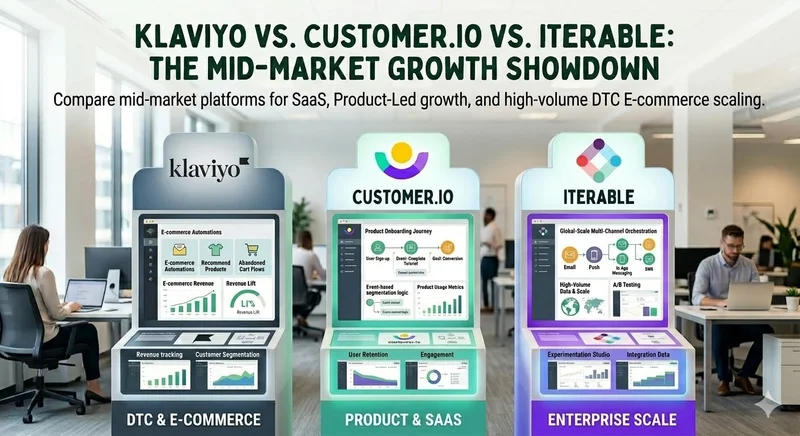
If you’re evaluating Klaviyo, Customer.io, or Iterable, you’re already playing at a different level than most businesses. All three are sophisticated marketing automation platforms that go far beyond basic email blasts. They support behavioral triggers, complex multi-channel journeys, real-time event data, and deep personalization.
So what actually separates them?
The answer comes down to who they were built for, and how opinionated they are about your data model. Get this right and your platform becomes a growth engine. Get it wrong and you’ll spend months working around it. Here’s the honest breakdown.
Klaviyo: E-Commerce Native, Remarkably Powerful Out of the Box
Klaviyo was built from the ground up for e-commerce, and its entire data model — contacts, events, products, orders — reflects that. This focus is both its greatest strength and its clearest signal about who it’s for.
Best for: E-commerce brands, DTC companies, and B2C businesses where purchase history and product behaviour are central to marketing.
What Klaviyo does well
- E-commerce integrations: Klaviyo’s native Shopify, WooCommerce, and BigCommerce integrations are best-in-class. Revenue data, product catalogues, browse abandonment, and predictive lifetime value are available immediately, no custom data pipeline required.
- No-code segmentation: You can build extraordinarily precise audience segments — based on purchase recency, frequency, predicted churn risk, email engagement — entirely through the UI without writing a single query.
- Pre-built flows: Abandoned cart, welcome series, post-purchase, win-back, sunset — Klaviyo ships with battle-tested automation templates that revenue teams can launch quickly and iterate on confidently.
- Revenue attribution: Every campaign and flow shows attributed revenue front and centre, making it easy to justify spend and optimize performance.
- Email + SMS in one: Klaviyo’s SMS is tightly integrated with its email automation, so omnichannel journeys — email on day 1, SMS on day 3 — are seamless to build.
When you’ll know you’re ready for more
Klaviyo’s strength is also its focus: it’s designed around e-commerce purchase events. As your business grows in complexity — particularly if you’re a SaaS product, a marketplace, or a company with intricate custom event taxonomies — you may find yourself working against Klaviyo’s opinionated data model rather than with it.
- Custom event schemas: If your product generates rich behavioural events that don’t map cleanly to orders and products, other platforms offer more flexibility in how you define and use event data.
- Developer-first workflows: Teams that want to manage their messaging logic in code, via API, or with version-controlled templates will find Customer.io or Iterable more ergonomic.
- Very large scale: At hundreds of millions of events or contacts, platforms built for enterprise-grade data volume may offer better performance and cost structures.
The bottom line: Klaviyo is the right choice for most e-commerce and DTC brands, and with the right implementation — clean data flows, well-structured flows, and proper list hygiene — it consistently delivers strong revenue results. The key is getting the setup right from day one.
Customer.io: Developer-Friendly, Event-Driven, Highly Flexible
Customer.io occupies a unique position: it’s powerful enough for sophisticated multi-channel automation, but approachable enough for lean teams. Its event-driven architecture makes it a natural fit for SaaS products, apps, and any business where user behaviour — not just purchase history — drives messaging.
Best for: SaaS companies, mobile apps, subscription businesses, and product-led growth teams who want precise behavioural messaging without enterprise complexity.
What Customer.io does well
- Event-driven flexibility: Customer.io accepts any event you send via API or SDK. There’s no rigid schema — your data model is your data model, and Customer.io works with it.
- Behavioural precision: You can trigger messages based on exactly what users do (or don’t do) inside your product — feature adoption events, trial milestones, inactivity windows, upgrade signals.
- Developer-friendly: Customer.io has a clean API, Liquid templating, and supports code-based workflow management. Engineering and marketing teams can collaborate naturally without one blocking the other.
- Multi-channel in one place: Email, SMS, push notifications, in-app messages, and webhooks all live in the same journey builder. Keeping your messaging coherent across channels is genuinely straightforward.
- Transparent pricing: Customer.io’s pricing is based on the number of profiles, with generous event limits — predictable and friendly for growing teams.
When you’ll know you’re ready for more
Customer.io is built for agility. That’s a feature, but very large enterprise organizations or businesses with extremely complex data governance needs may eventually look for more.
- Advanced reporting: Customer.io’s analytics are solid but less deep than enterprise platforms. Teams that need sophisticated attribution modelling or multi-touch revenue reporting may want to supplement with a BI tool.
- High-volume enterprise scale: For organizations managing tens of millions of active profiles with complex compliance requirements across multiple brands and regions, enterprise platforms like Iterable or SFMC offer more governance infrastructure.
- Prebuilt e-commerce depth: If purchase-event marketing is your primary use case, Klaviyo’s native e-commerce data model will save you significant setup time versus building equivalent logic in Customer.io.
The bottom line: Customer.io is an excellent platform for product-first companies that value flexibility and developer collaboration. A well-architected Customer.io implementation — with clean event taxonomy, thoughtful journey design, and proper segment logic — gives lean teams the ability to run remarkably sophisticated messaging programs.
Iterable: Enterprise Multi-Channel, Built for Scale and Complexity
Iterable is the enterprise option in this comparison. It was purpose-built to handle multi-channel messaging at very large scale, and it shows in the breadth of its channel support, its data model flexibility, and its enterprise governance features. It asks more of the teams that implement it, and rewards them accordingly.
Best for: Enterprise and upper mid-market companies, businesses with large and diverse user bases, and organizations that need robust multi-channel orchestration across email, SMS, push, in-app, and web with enterprise-grade governance.
What Iterable does well
- True multi-channel orchestration: Email, SMS, push notifications, in-app messages, web push, and direct mail can all be orchestrated within a single workflow. Iterable was designed from the start to treat all channels as equals.
- Flexible data model: Iterable can ingest and act on virtually any data you send — user attributes, event data, catalogue data — making it adaptable to complex or non-standard data architectures.
- Enterprise governance: User roles, approval workflows, brand management across multiple product lines, and compliance controls are built into the platform at a level that enterprise organizations require.
- AI and optimization features: Iterable’s AI capabilities — send-time optimization, channel fatigue management, predictive goals — are mature and genuinely useful at scale.
- Experiment framework: Iterable’s built-in A/B and multivariate testing tools are among the most sophisticated available, with journey-level holdout groups and statistical significance tracking.
When you’ll be ready to level up
Iterable’s enterprise positioning means it comes with enterprise expectations — in terms of implementation effort, team capability, and investment.
- Implementation complexity: Iterable is not a self-serve platform. Getting the most out of it requires a structured implementation with proper data architecture, channel configuration, and team training. With the right partner, this investment pays off at scale.
- Cost: Iterable’s pricing reflects its enterprise positioning. For businesses not yet at the scale where that investment is justified, Customer.io or Klaviyo will deliver better ROI.
- Time to value: Like any enterprise platform, a proper Iterable implementation takes time to do right. The reward is a system that scales with you for years without needing to be rebuilt.
The bottom line: Iterable is a formidable platform for organizations that need enterprise-grade multi-channel orchestration. The teams that get the most out of it are those who invest in a proper implementation — clean data architecture, well-designed journeys, and ongoing optimization from people who know the platform deeply.
Side-by-Side Comparison
| Klaviyo | Customer.io | Iterable | |
|---|---|---|---|
| Best for | E-commerce, DTC brands | SaaS, apps, PLG teams | Enterprise, large-scale orgs |
| Data model | E-commerce native | Fully flexible (any events) | Flexible, enterprise-grade |
| Technical skill required | Low-to-moderate | Moderate (developer-friendly) | High |
| E-commerce depth | Best-in-class | Good (with setup) | Good (with setup) |
| Multi-channel | Email + SMS | Email, SMS, Push, In-App | Email, SMS, Push, In-App, Web, Direct Mail |
| Developer experience | Good | Excellent | Good |
| Pricing model | Contact-based | Profile-based, predictable | Enterprise licensing |
| Implementation time | Days to weeks | Weeks | Months |
| Ideal scale | 5,000 – 500,000+ contacts | 1,000 – 5M+ users | 500,000+ users |
How to Choose
Choose Klaviyo if: Your primary channel is e-commerce, you want powerful segmentation and automation without heavy engineering involvement, and revenue attribution is central to how you measure success.
Choose Customer.io if: You run a SaaS product or app, you want to trigger messages based on product behaviour rather than purchase events, and you value developer-friendly tooling with flexible pricing.
Choose Iterable if: You’re an enterprise or fast-scaling company that needs true multi-channel orchestration at significant scale, strong governance features, and a platform built to handle the complexity of a large and diverse user base.
Getting the Most Out of Whichever Platform You Choose
The platform decision is just the beginning. The teams we’ve seen succeed on all three of these platforms share one thing in common: they invested in getting the data architecture right before building campaigns. Clean event taxonomy, well-structured user profiles, and thoughtful journey design aren’t glamorous — but they’re what separates a platform that drives measurable growth from one that just sends emails.
Whether you’re implementing from scratch, migrating from another tool, or trying to unlock more value from a platform you’re already paying for, our certified CRM experts are happy to talk through the right approach for your situation.