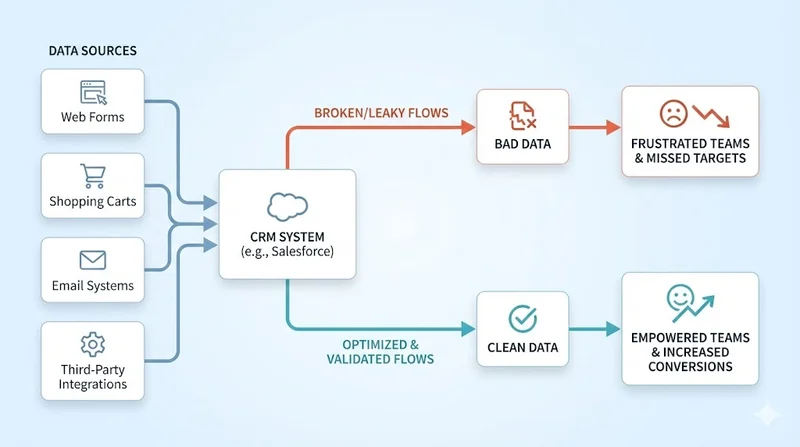
At Hesper, we specialize in scalable, data-driven solutions that drive business growth. But before you can scale, you need a foundation you can trust. Often, companies invest heavily in top-tier CRM platforms like Salesforce, only to find their sales reps ignoring the data and their marketing campaigns falling flat. The culprit? Poor data correctness.
Data correctness isn’t just an IT concern; it’s a revenue issue. When your data flows are broken, your teams lose faith in the system, leading to missed opportunities and wasted budgets.
The Ripple Effect of Bad Data Flows
Imagine a scenario where a high-value lead fills out a form on your website. Due to a broken integration or a misconfigured trigger, that lead’s “Industry” field is overwritten with blank data, or worse, they are routed to the wrong sales territory. What happens next?
- Sales Friction: Your sales team wastes time researching basic information that should have been provided. Or, the lead sits untouched because it wasn’t routed correctly.
- Marketing Misfires: Your marketing team tries to send a targeted email campaign to the “Healthcare” sector, but because the data flow failed, this high-value lead is excluded from the segment.
- Erosion of Trust: When reps notice these errors, they stop relying on the CRM. They revert to spreadsheets, siloing critical business intelligence.
Fixing the Foundation: Auditing Data Flows
To increase conversions, you must ensure that data moves seamlessly and accurately from capture to conversion.
Here is how our certified technical CRM experts typically address this:
- Comprehensive System Audit: We map every entry point—from web forms and shopping carts to third-party integrations. We track the data payload to ensure fields map correctly to the corresponding CRM objects.
- Trigger Optimization: We review existing Apex triggers and automated workflows to ensure they fire in the correct order and don’t inadvertently overwrite critical data points.
- Implementing Validation Rules: We enforce data hygiene at the point of entry, ensuring that critical fields are formatted correctly (e.g., standardizing phone numbers or requiring specific drop-down selections) before they enter the database.
The Conversion Impact of “Clean” Data
When your data architecture is solid and your data is correct, the impact is transformative:
Personalization at Scale: Marketing can finally trust their segmentation. Instead of generic blasts, they can build complex, automated journeys triggered by precise behaviors and accurate demographic data.
Faster Speed-to-Lead: Sales reps receive fully enriched, accurately routed leads the moment they are generated. They can immediately see a prospect’s history, enabling highly contextual and persuasive conversations.
Setting up your CRM from the ground up, fixing your data flows, or custom-coding a new trigger can be complex, but you don’t have to do it alone. By prioritizing data correctness, you empower your teams to stop fighting the system and start closing deals.